A photo shows you the result; a video shows you the cause. Film when you can see what is wrong in your saved photos but not why: the footage reveals pour height, flow rate, and timing.
You need one phone and something to prop it on. The angle matters more than the camera.
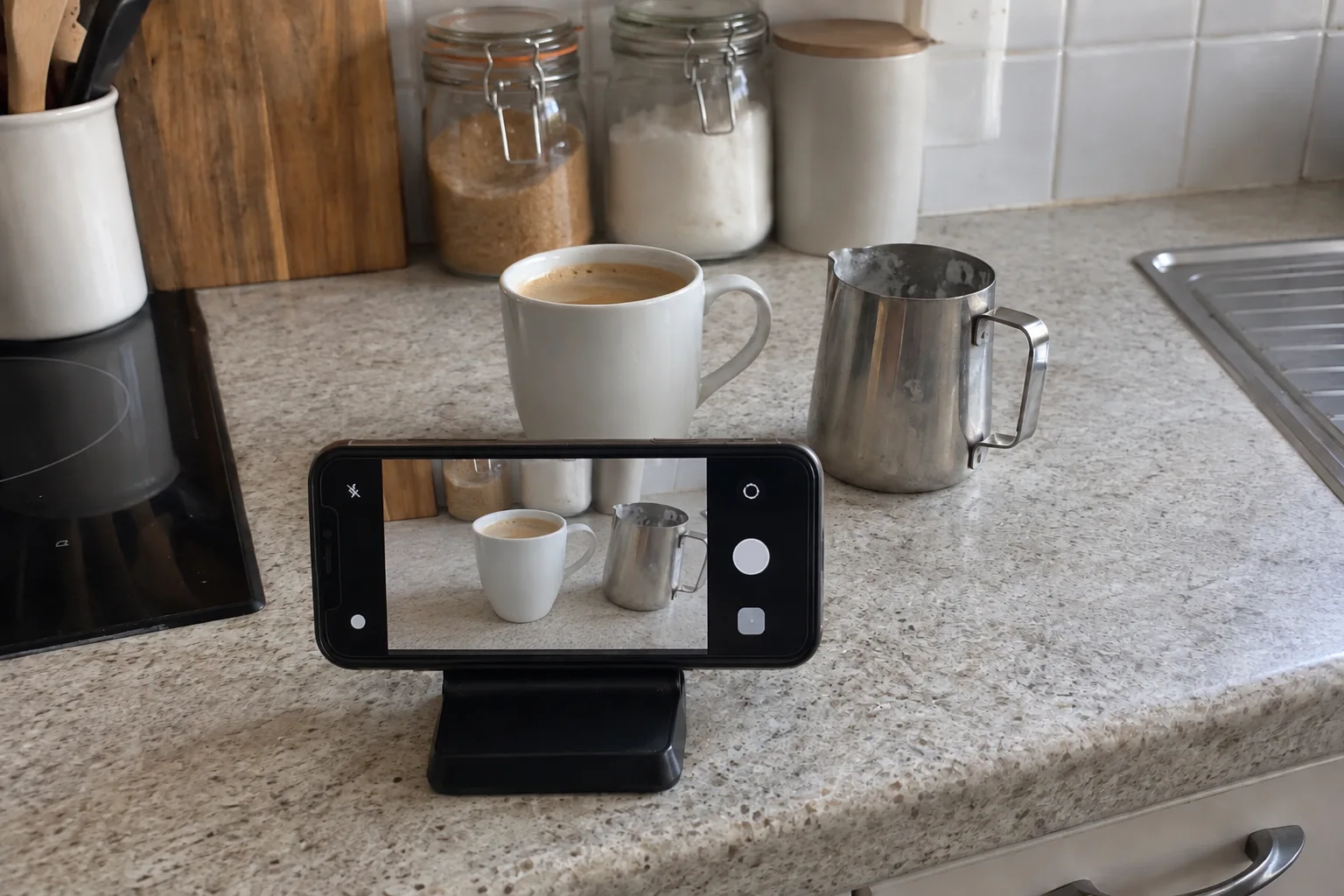
Angle 1: Side view (the most useful)
Prop the phone at cup height, perpendicular to your pouring arm, close enough that the pitcher spout and cup surface fill the frame.
What it reveals:
- Pour height. You will see immediately whether “low” was actually low. Most beginners discover they hover a centimetre too high.
- The drop moment. Exactly when the spout came down — and whether the cup was already too full.
- Cup tilt. Whether the cup levelled smoothly or jerked upright mid-push.
This angle answers the most common question, “why did no white appear?”, better than any other.
Angle 2: Top-down view
Mount or hold the phone directly above the cup. A stack of books and a bit of patience works; watch for steam fogging the lens.
What it reveals:
- Centre-line drift. Whether the stream stayed on the cup’s middle line or wandered — drift is the usual cause of lopsided designs.
- Wiggle evenness. For ripple hearts and rosettas, you can see whether the swing was symmetrical.
- Design growth. Where on the surface the pattern started and how it spread.
Angle 3: Over-your-shoulder view
Behind and above your pouring shoulder, mimicking your own viewpoint.
What it reveals: what you could see during the pour. Useful for noticing that your view was blocked by the pitcher, or that you were watching the wrong thing, like the cup wall instead of the surface.
What to ignore in the footage
- Audio and commentary. Skip narrating; it slows the review.
- The first second of milk leaving the pitcher. Everyone’s start is messy.
- Judging aesthetics. You are looking for one mechanical fact per viewing.
A review loop that stays quick
- Film one or two pours per session — not every pour, or review becomes a second job.
- Watch once at full speed, once paused at the moment white appears (or should have).
- Write one sentence: “dropped too late” or “flow pulsed during the wiggle.”
- Save the sentence with the pour’s photo.
Saved next to the photo, that sentence is what the next session starts from. LatteArtist keeps photos, ratings, and notes together per pour, so when you film again a week later you can check whether the fix held.
Once the footage tells you what is wrong, the troubleshooting guide maps each visible problem to the change to try next.