A ripple heart is a solid heart poured with a gentle side-to-side wiggle during the push, so concentric rings stack around the white circle before you cut through. It teaches the rosetta’s wiggle without the rosetta’s pull-back.
If you can pour a centred solid heart most of the time, you are ready for this one.
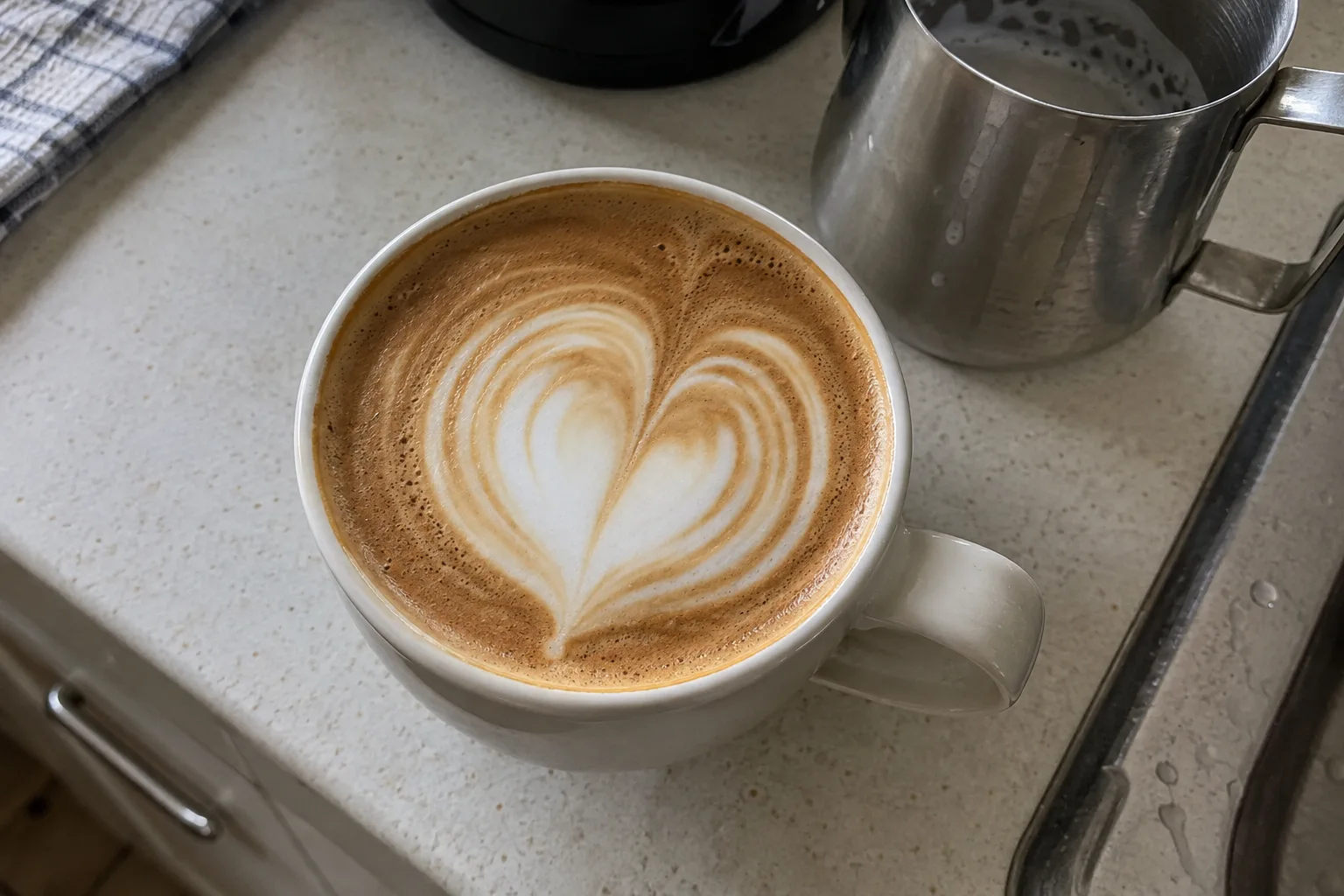
What the wiggle is
The wiggle is a small, even side-to-side movement of the pitcher, driven from the wrist, while the spout stays close to the surface. The stream should swing a few millimetres each way — not the whole pitcher travelling across the cup.
Two rules make it work:
- Flow stays constant. The wiggle changes direction, not rate. If flow pulses with each swing, you get blobs instead of rings.
- The spout stays low. Lift even slightly and the rings stop forming.
Step by step
- Set the base. Tilt the cup, pour high and steady into the centre until the cup is about half full, exactly as for a solid heart.
- Drop low and start the push. Bring the spout close to the surface and increase flow until white appears.
- Start with a small wiggle. Once the white circle is stable, begin a gentle wrist wiggle — two or three swings per second is plenty. Rings should start wrapping around the incoming stream.
- Hold your position. Unlike a rosetta, you do not pull back. Stay in the centre and let the rings stack outward.
- Cut through. Ease the flow, lift slightly, and pull a thin stream through the middle. The cut turns the ringed circle into a pointed heart with ripples on both lobes.
What you should see at each stage
- After step 3: faint concentric lines, evenly spaced on both sides. Uneven spacing means uneven swing speed.
- After step 4: a ringed circle about the size you want the heart to be. It will not grow during the cut.
- After step 5: clean ripples on the upper two-thirds, a sharp point at the bottom.
Common failures and their fixes
| What showed up | Likely cause | Try next |
|---|---|---|
| Solid heart, no rings | Wiggle too small or too slow | Exaggerate the swing; speed will come later |
| Zigzag lines, not rings | Wiggle too wide and fast | Halve the swing width, keep the flow steady |
| Blobs between rings | Flow pulsing with the wiggle | Practise the wrist motion over water first |
| Washed-out rings | Spout lifted during the wiggle | Keep the spout almost touching the surface |
| Lopsided ripples | Cup tilted or spout off-centre | Check alignment before dropping low |
A dry-run drill
Before your next coffee, fill the pitcher with water and practise the wiggle into an empty sink or jug: constant flow, small swings, thirty seconds. You are training the wrist separately from everything else, so that on a real pour the only new element is the milk.
Log your first ten ripple-heart attempts with a photo and one line on the wiggle (“too wide”, “flow pulsed”). In LatteArtist, comparing those attempts side by side shows the wiggle settling down far faster than memory does.
Next step: the winged tulip stacks this same wiggle into layers, and the full rosetta adds the pull-back.